
Abstract
Internal fogging in double-glazed casement windows is one of the most commercially significant failure modes in the glazing industry. When moisture appears between the panes — impossible to wipe away, persistent regardless of weather — the insulated glass unit (IGU) has lost its hermetic integrity. For procurement managers specifying commercial or residential projects, and for contractors responsible for installation quality, understanding why this happens is prerequisite knowledge for avoiding costly callbacks, warranty disputes, and thermal performance losses.
This article dissects the technical mechanisms behind internal condensation: how the IGU cavity is engineered to remain dry, what causes the seal system to degrade, and how compliance standards such as EN 1279 and ASTM E2190 define acceptable performance thresholds. It also provides a practical framework for evaluating remediation options and making procurement decisions that reduce the probability of premature seal failure in double-glazed casement window installations.
1: The Science Behind Internal Fogging in Double-Glazed Units
1.1: How the Insulated Glass Unit (IGU) Maintains a Fog-Free Cavity
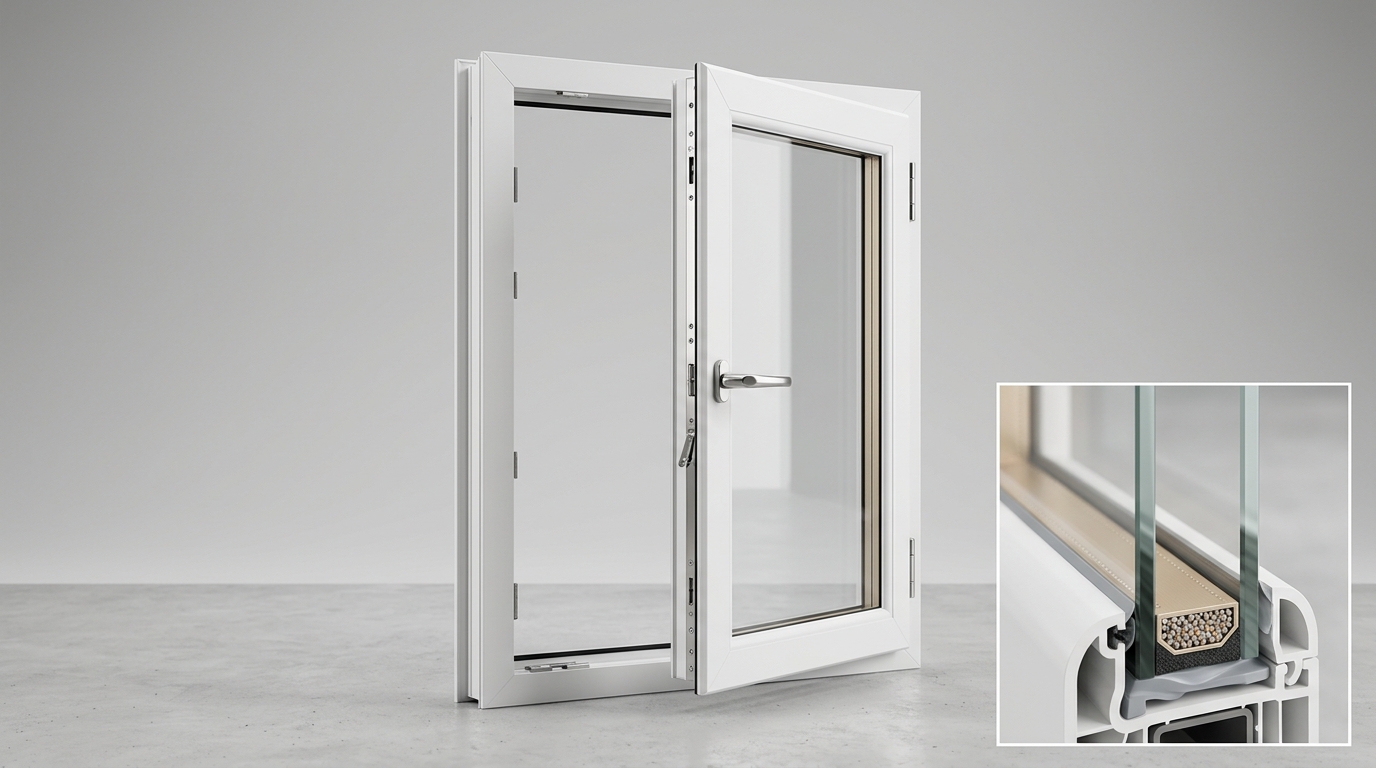
A double-glazed casement window achieves its thermal and acoustic performance through a precisely engineered cavity between two glass lites. That cavity is filled with an inert gas — typically argon (90–95% fill concentration) or krypton for higher-specification units — which has lower thermal conductivity than air, reducing heat transfer across the unit.
The structural integrity of this gas-filled space depends on two components working in concert. The spacer bar, positioned around the perimeter of the cavity, contains a desiccant material (typically molecular sieve or silica gel) that absorbs residual moisture trapped during manufacture. The dual-seal system — a primary polyisobutylene (PIB) seal applied directly to the glass edge and a secondary structural seal of silicone or polysulfide — creates the hermetic barrier that prevents gas escape and moisture ingress.
As long as both seals remain intact and the desiccant retains capacity, the cavity stays dry and optically clear. The system is designed to tolerate normal thermal cycling across decades of use. When any element of this system is compromised, the cavity is no longer isolated from the external environment.
1.2: Why Condensation Forms Between the Panes
Condensation between panes occurs when the dew point inside the cavity is exceeded — that is, when moisture concentration rises to the point where water vapour converts to liquid droplets on the inner glass surfaces. This is not surface condensation; it is a cavity-internal event that signals irreversible seal compromise.
The ingress pathway is typically microscopic at first. Thermal cycling creates a daily pressure differential: the gas inside the cavity expands when heated and contracts when cooled, creating a pumping action that progressively stresses the seal perimeter. Once micro-fractures develop in the PIB primary seal, humid external air is drawn inward during contraction cycles. The desiccant initially absorbs this moisture, masking the failure. When desiccant capacity is exhausted — which may take months or years — fogging becomes visible, particularly on cold mornings when the inner pane temperature drops below the cavity dew point.
At this stage, the IGU’s thermal performance has already degraded measurably. The presence of moisture also accelerates further seal deterioration through freeze-thaw cycling in cold climates.
2: Root Causes of Seal Failure in Casement Window Units
2.1: Material Degradation and Manufacturing Defects
The PIB primary seal is the first line of defence against gas loss and moisture ingress. PIB is highly resistant to gas permeation but is susceptible to creep under sustained compressive load and to degradation when exposed to certain cleaning agents, particularly those containing acetone or ammonia. Over time — typically beyond 15–20 years in well-manufactured units — PIB loses elasticity, and micro-fractures develop.
The secondary seal (silicone or polysulfide) provides structural bonding and additional moisture resistance. Silicone offers superior UV resistance and flexibility across temperature extremes; polysulfide provides better gas retention but is less flexible. UV degradation of the secondary seal at exposed edges — particularly in south-facing casement windows without adequate overhang shading — can reduce service life significantly.
Manufacturing defects that accelerate failure include: insufficient edge deletion (failure to remove the low-E coating from the glass perimeter before sealing, which reduces adhesion), non-uniform PIB application creating voids, and incorrect gas fill percentages that generate higher-than-designed pressure differentials during thermal cycling.
2.2: Installation Errors and Frame-Related Stress
Even a correctly manufactured IGU will fail prematurely if installation introduces mechanical stress to the seal perimeter. The most common installation errors in double-glazed casement window projects include:
- Incorrect glazing tape or setting block positioning, which concentrates point loads on the glass edge rather than distributing them across the frame rebate
- Inadequate drainage clearance in the frame, allowing water to pool at the sill and saturate the secondary seal
- Frame distortion from improper fixings or out-of-square openings, which transfers shear loads directly to the IGU seal line
| Failure Mode | Trigger Condition | Typical Onset | Visual Symptom | Repairable? |
|---|---|---|---|---|
| PIB primary seal aging | UV exposure, thermal cycling | 15–25 years | Uniform misting across pane | IGU replacement only |
| Installation stress fracture | Frame distortion, point loading | 1–5 years | Edge-concentrated fogging | IGU replacement only |
| Cleaning agent attack | Solvent-based cleaners on edge seals | 2–10 years | Localised seal discolouration + misting | IGU replacement only |
| Extreme climate cycling | Temperature range >60°C daily swing | 5–15 years | Progressive misting, gas loss | IGU replacement only |
| Desiccant saturation | High-humidity environment, minor seal breach | 3–8 years | Morning fogging, clears by afternoon | IGU replacement only |
| Edge deletion error (manufacturing) | Low-E coating not removed at seal zone | 1–3 years | Early-onset, uniform misting | IGU replacement only |
3: Industry Standards and Performance Benchmarks
3.1: Relevant Compliance Standards for IGU Seal Longevity
Two primary standards govern IGU performance in international markets. EN 1279 (Parts 1–6) is the European framework covering gas fill verification, moisture penetration resistance, and long-term seal durability testing. Compliant units must demonstrate gas fill retention above 90% of initial concentration after accelerated aging cycles and moisture penetration index values within defined thresholds.
ASTM E2190 is the North American equivalent, specifying fogging resistance and seal durability requirements through standardised thermal cycling and humidity exposure tests. Units carrying this certification have demonstrated resistance to the failure modes described above under controlled laboratory conditions.
Warranty periods are a practical proxy for manufacturer confidence in seal longevity. Industry-standard warranties for commercial double-glazed casement window units range from 10 to 15 years for standard aluminium spacer systems and 15 to 25 years for warm-edge spacer configurations. Warranties that fall below 10 years on a new installation should be treated as a procurement risk indicator.
3.2: How to Evaluate IGU Quality Before Procurement
Procurement teams should request the following verification data from suppliers before committing to large-volume orders:
- Gas fill percentage at point of manufacture, verified by third-party testing or supplier-provided spectroscopic analysis documentation
- Spacer bar material specification: warm-edge spacers (foam, thermoplastic, or stainless steel hybrid) outperform aluminium in condensation resistance at the sight line and reduce edge-zone heat loss by up to 60%
- Third-party certification marks: CE marking (EN 1279), British Standards Kitemark, or equivalent national certification confirm independent audit of the manufacturing process
- Low-E coating compatibility: confirm that edge deletion has been performed to the correct width for the specified seal system — typically 3–5 mm minimum
4: Remediation Options and Procurement Considerations
4.1: Repair vs. Full IGU Replacement — Decision Criteria
Once internal fogging is confirmed, the remediation decision reduces to a straightforward cost-benefit analysis. In-situ defogging services — which drill small holes into the cavity, inject cleaning agents, and insert new desiccant plugs — are marketed as a low-cost alternative to replacement. However, this approach does not restore gas fill, does not repair the failed seal, and provides only temporary visual improvement. Thermal performance remains degraded. For commercial applications where U-value compliance is a contractual or regulatory requirement, defogging is not an acceptable remediation.
Full IGU replacement — retaining the existing frame and replacing only the glass unit — is the standard commercial solution. Lead times for replacement units from established manufacturers typically range from 5 to 15 working days for standard sizes, and 3 to 6 weeks for bespoke configurations. The cost threshold at which full frame replacement becomes more economical than IGU-only replacement generally occurs when frame condition is also compromised, or when the unit is more than 20 years old and frame seals are approaching end of service life.
4.2: Selecting a Replacement Double-Glazed Casement Window Unit
When specifying replacement units, procurement managers should prioritise the following criteria:
- Warm-edge spacer technology as a standard specification, not an upgrade, for any project in a climate with significant seasonal temperature variation
- Low-E coating specification matched to orientation: solar control low-E for south-facing elevations, high-transmittance low-E for north-facing elevations
- Frame rebate dimensions verified against existing opening: a 2 mm tolerance error in rebate depth can introduce the same installation stress conditions that caused the original failure
- Supplier quality indicators: ISO 9001-certified manufacturing, documented gas fill QC procedures, and a minimum 15-year seal warranty on the replacement unit
FAQ
Can a fogged double-glazed casement window be repaired without replacing the entire frame?
Yes — in most cases, only the IGU requires replacement, not the entire frame assembly. Provided the frame remains structurally sound, dimensionally accurate, and free from seal degradation, a glazier can remove the failed unit and install a replacement IGU within the existing frame. This is significantly more cost-effective than full window replacement and is the standard remediation approach in commercial refurbishment projects.
How long should the seal on a double-glazed unit last under normal commercial use conditions?
Under EN 1279 or ASTM E2190-compliant manufacturing conditions, with correct installation and routine maintenance, a double-glazed casement window IGU should maintain seal integrity for 15 to 25 years. Warm-edge spacer systems consistently outperform aluminium spacer units at the upper end of this range. Units failing within 5 years should be assessed for installation error or manufacturing defect as primary causes.
Does internal condensation between panes affect the thermal performance (U-value) of the window?
Yes, measurably. Gas fill loss — which accompanies seal failure — replaces the low-conductivity argon or krypton with ambient air, increasing the unit’s centre-pane U-value by approximately 0.3–0.5 W/m²K depending on original specification. Additionally, moisture deposits on inner glass surfaces reduce solar transmittance and visible light transmission. For buildings subject to energy performance compliance requirements, a fogged IGU constitutes a non-compliant component that must be addressed.
Conclusion
Internal fogging in double-glazed casement windows is a deterministic failure: when the hermetic seal degrades, moisture ingress and gas loss follow predictably. The root causes — PIB aging, UV-driven secondary seal breakdown, installation-induced stress, and manufacturing defects — are well understood and largely preventable through rigorous procurement standards and correct installation practice.
Compliance with EN 1279 or ASTM E2190 provides a baseline quality assurance framework, but procurement teams should go further: specifying warm-edge spacer technology, verifying gas fill documentation, and requiring minimum 15-year seal warranties as standard contract terms. When fogging does occur, full IGU replacement is the only remediation that restores both visual clarity and thermal performance. Selecting replacement units from certified manufacturers with documented QC processes is the single most effective measure for reducing the probability of repeat failure within the service life of the installation.