
Abstract
Large double-glazed casement windows occupy a unique position in commercial construction: they deliver expansive glazing areas, superior thermal performance, and natural ventilation — yet their size introduces structural variables that standard residential-grade products cannot address. For procurement teams specifying windows in high-rise residential towers, hospitality developments, healthcare campuses, or educational facilities, “safe and durable” must be quantifiable, not assumed.
This article examines the engineering systems that determine whether a large-format casement window performs reliably over its service life: multi-point locking hardware, reinforced frame profiles, insulated glass unit (IGU) longevity, and wind load compliance. Each section references the applicable international standards — EN 12210, EN 1627, EN ISO 10077, and regional codes — so specifiers can translate technical requirements directly into supplier qualification criteria. Whether you are sourcing for a single landmark project or establishing a procurement framework across multiple sites, the benchmarks below provide a structured foundation for confident decision-making.
1. Structural Safety: What Makes Large Casement Windows Secure
1.1 Multi-Point Locking Systems
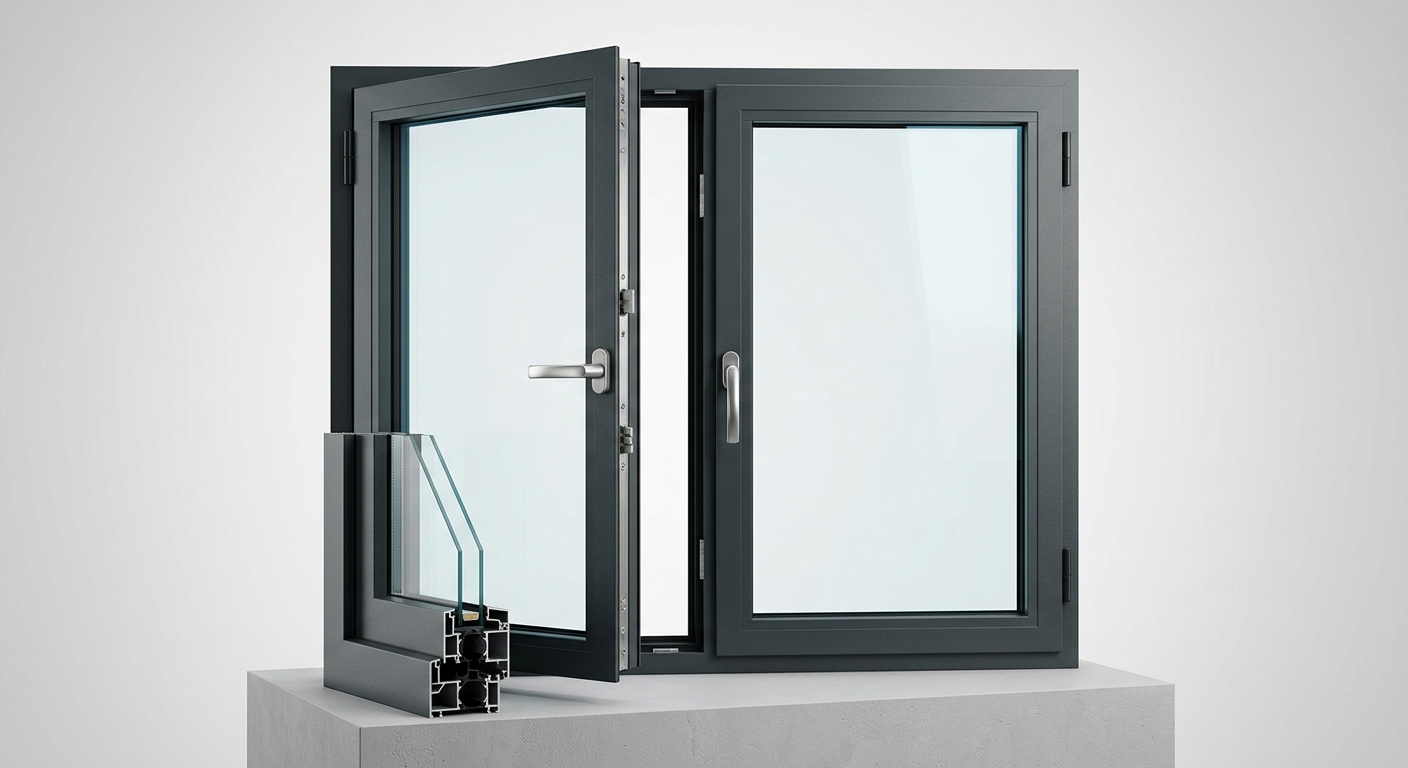
In a standard single-point lock, the entire closing force concentrates at one hardware contact, leaving the sash perimeter vulnerable to deflection — a critical weakness when sash dimensions exceed 1,200 mm in height or width. Multi-point locking systems resolve this by distributing clamping force across three to seven engagement points along the frame perimeter, typically at the top rail, bottom rail, and intermediate positions on the stile.
From a structural standpoint, this distribution reduces the bending moment on the sash under both wind pressure and attempted forced entry. Hardware conforming to EN 1935 (hinge performance) and ANSI/BHMA A156.115 (North American hardware lifecycle) must demonstrate a minimum of 25,000 operational cycles without degradation in clamping force or alignment. For large casement windows, specifiers should require hardware rated to at least Grade 13 under EN 1935, which corresponds to heavy commercial use.
Beyond security, multi-point engagement directly supports long-term airtightness. Each locking point compresses the perimeter gasket consistently, preventing the localized seal failures that develop when a large sash is held closed at only one point over years of thermal cycling.
1.2 Reinforced Frame Engineering for Large Spans
uPVC profiles are the dominant choice in commercial casement windows due to corrosion resistance and thermal efficiency, but unreinforced uPVC cannot sustain the structural loads imposed by large glazing panels. Industry practice mandates steel or aluminum reinforcement inserts within the main frame and sash profiles whenever sash width exceeds approximately 900 mm or height exceeds 1,500 mm — though project-specific wind load calculations may lower these thresholds.
Key engineering parameters for reinforced large-format frames include:
- Minimum wall thickness: uPVC outer profiles should meet a minimum 2.8 mm wall thickness (Class A per EN 12608) to accommodate reinforcement without compromising the weld zone.
- Corner joint reinforcement: Fusion-welded corners in uPVC must be supplemented with internal corner brackets or continuous steel reinforcement that bridges the joint, preventing corner spread under sustained load.
- Aluminum system profiles: For spans exceeding 1,800 mm width, thermally broken aluminum extrusions with a minimum 1.4 mm wall section offer superior stiffness-to-weight ratios and are preferred in high-wind-zone specifications.
Structural calculations should be submitted by the supplier for any sash exceeding 2.4 m² in area, referencing the applicable wind load zone for the project location.
2. Double-Glazing Performance: Durability Under Real-World Conditions
2.1 Insulated Glass Unit (IGU) Construction & Longevity
The durability of the IGU — not just the frame — determines whether a large double-glazed casement window maintains its thermal and acoustic performance over a 20–25 year service life. Two construction variables have the greatest long-term impact: spacer bar specification and primary/secondary seal integrity.
Warm-edge spacer bars (polymer composite or stainless steel with thermal breaks) reduce edge-zone condensation and lower the linear thermal transmittance (Ψ-value) compared to conventional aluminum spacers. In large IGUs, where the edge zone represents a proportionally smaller fraction of total glazing area, the thermal benefit is moderate — but the reduction in thermal stress cycling at the glass edge extends seal lifespan measurably.
Gas retention is the second critical metric. Argon-filled units from reputable manufacturers maintain ≥90% gas concentration after 10 years when dual-seal construction (polyisobutylene primary, polysulfide or silicone secondary) is used. Krypton fill is specified for units where cavity width is constrained to 8–10 mm, typically in slim-profile aluminum systems. Buyers should request third-party test data confirming gas retention per EN 1279-3 rather than relying on manufacturer claims alone.
2.2 Wind Load & Impact Resistance Standards
Wind resistance classification under EN 12210 assigns casement windows to Classes 1 through 5, corresponding to design wind pressures from 400 Pa (Class 1) to 2,000 Pa (Class 5). Large-format casement windows for high-rise or coastal commercial projects typically require Class 4 (1,600 Pa) or Class 5 (2,000 Pa) certification, which demands both frame stiffness and IGU edge-seal integrity under sustained and cyclic loading.
Complementary performance classifications under EN 12207 (air permeability, Classes 1–4) and EN 12208 (water tightness, Classes 1A–9A) complete the weathertightness profile. For projects in hurricane or severe storm zones, Product Approval (NOA) certification in Florida or PGT/AAMA 506 compliance in North America provides the impact resistance verification that EN standards do not fully address.
📊 Large Double-Glazed Casement Window — Key Performance Parameter Comparison
Parameter Standard Range High-Performance Grade Test Standard Max. Sash Size (W × H) 900 × 1,500 mm 1,400 × 2,400 mm Supplier structural calc. Wind Load Class Class 2 (600 Pa) Class 5 (2,000 Pa) EN 12210 Air Permeability Class Class 2 Class 4 EN 12207 Water Tightness Class Class 4A Class 9A EN 12208 Security Rating RC1 RC3 EN 1627 Thermal Transmittance (Uw) 1.6 W/m²K 0.9 W/m²K EN ISO 10077 Frame Reinforcement Type Steel insert (uPVC) Thermally broken aluminum —
3. Compliance & Certification: Meeting Commercial Project Requirements
3.1 Relevant International Standards & Building Codes
For EU projects, CE marking under the Construction Products Regulation (CPR) is mandatory, requiring Declaration of Performance (DoP) against EN 14351-1 for external windows. This covers wind resistance, air permeability, water tightness, and thermal transmittance — the four parameters most critical to large-format casement specification.
In the UK post-Brexit, Building Regulations Part L (energy efficiency) and Part Q (security) set the minimum performance thresholds. Part Q specifically requires windows in accessible locations to meet PAS 24:2022, which includes enhanced security testing beyond basic EN 1627 compliance.
North American procurement teams should reference AAMA/WDMA/CSA 101/I.S.2/A440 (NAFS) for performance grading, with Performance Class CW (Commercial Window) or AW (Architectural Window) applicable to large-format commercial casements. Third-party certification bodies including the British Fenestration Rating Council (BFRC), ift Rosenheim, and Intertek provide independent verification that suppliers’ self-reported DoP data is substantiated.
3.2 Security Classification & Burglar Resistance
EN 1627 defines six Resistance Classes (RC1–RC6) for windows and doors. For commercial ground-floor and lower-floor applications, RC2 is the standard minimum, requiring resistance to manual attack for at least three minutes using common tools. High-value commercial premises — financial institutions, data centers, pharmaceutical facilities — typically specify RC3, which adds resistance to experienced attack with a second set of tools.
PAS 24 compliance, required under UK Building Regulations Part Q, aligns broadly with RC2 but includes additional tests for frame integrity under crowbar attack that EN 1627 RC2 does not fully replicate. Procurement teams specifying for UK projects should require explicit PAS 24 test reports, not just EN 1627 equivalence claims. Hardware certification — locks, hinges, and keeps — must be tested as an integrated assembly, not as individual components.
4. Commercial Applications & Procurement Considerations
4.1 Typical B2B Application Scenarios
Large double-glazed casement windows serve distinct functional roles across commercial sectors:
- High-rise residential: Ventilation requirements drive casement selection over fixed glazing; wind load Class 4–5 and RC2 security are standard specification minimums above the fifth floor.
- Hospitality: Floor-to-ceiling casements in guest rooms and public areas prioritize Uw values ≤1.2 W/m²K and acoustic performance (Rw ≥ 35 dB); thermally broken aluminum frames dominate.
- Healthcare & education: Restricted opening limiters (compliant with EN 14351 and local fall prevention codes) are mandatory; uPVC reinforced frames are preferred for low-maintenance operation.
- Heritage and retrofit: Slim-profile thermally broken aluminum or engineered timber replicates original aesthetics while meeting current Part L/Part Q requirements.
For any project exceeding 50 units, specifiers should request a sample window for independent third-party testing against the project’s specific wind zone and security classification before committing to full procurement.
4.2 Total Cost of Ownership vs. Upfront Specification
Frame material selection has the largest impact on total lifecycle cost. A comparative overview:
- uPVC reinforced: Lowest upfront cost; 25–35 year service life with minimal maintenance; color stability subject to UV exposure class (EN 513); industry-standard warranty 10–15 years.
- Thermally broken aluminum: Higher initial cost offset by 40–50 year structural lifespan; powder coat finish warranties typically 25 years (Qualicoat Class 2); preferred for curtain wall integration.
- Engineered timber: Premium upfront cost; 5–7 year recoating cycle adds lifecycle cost; appropriate for heritage projects where planning conditions restrict aluminum.
Supplier qualification should include: traceable CE/UKCA certification documentation, independent test reports (not in-house), minimum 10-year IGU seal warranty, and demonstrated project references at comparable scale and wind zone.
SSS
Q1: What is the maximum recommended size for a double-glazed casement window before structural reinforcement becomes mandatory?
There is no universal maximum, as the threshold depends on wind load zone, frame material, and IGU weight. As a practical guideline, steel or aluminum reinforcement within uPVC profiles is required when sash area exceeds approximately 1.35 m² (e.g., 900 × 1,500 mm). For aluminum systems, supplier-provided structural calculations are required for sashes exceeding 2.4 m². Always obtain project-specific engineering sign-off.
Q2: How do multi-point locking systems affect the long-term airtightness and weatherproofing of large casement windows?
Multi-point locking distributes gasket compression evenly around the sash perimeter, preventing the localized seal degradation that single-point locks cause over time. This directly maintains EN 12207 air permeability class and EN 12208 water tightness class throughout the product’s service life — a measurable benefit in energy-performance-regulated commercial buildings.
Q3: Which international certifications should procurement teams require from suppliers to ensure wind resistance and security compliance?
At minimum: CE marking with DoP against EN 14351-1 (EU), UKCA marking with PAS 24 test report (UK), or NAFS CW/AW classification (North America). For security, require EN 1627 RC2 or RC3 test reports from an accredited laboratory. For hurricane zones, NOA or AAMA 506 certification is non-negotiable.
Sonuç
Large double-glazed casement windows can fully meet demanding commercial safety and durability requirements — but only when engineered with verified multi-point locking hardware, adequately reinforced frame profiles, and IGUs constructed to recognized longevity standards. The performance gap between a standard residential casement and a properly specified commercial large-format unit is substantial, and that gap is defined by traceable certification, not marketing claims.
Procurement teams should prioritize suppliers who provide independent test reports against EN 12210, EN 1627, and applicable regional building codes, and who offer structural calculations for oversized sash configurations. Evaluating total lifecycle cost — factoring in frame material durability, IGU warranty terms, and maintenance cycles — alongside initial specification cost will consistently deliver better long-term project value than optimizing for upfront price alone.