

Abstract
Condensation on entrance doors is more than a cosmetic nuisance — it signals thermal inefficiency, accelerates structural deterioration, and compromises indoor air quality. For commercial and residential procurement teams, a door that “sweats” represents ongoing maintenance liability, potential mold risk, and measurable heating energy loss. Aluminum double-glazed entrance doors are frequently specified for their durability and aesthetics, yet without the correct thermal engineering, aluminum’s inherent conductivity makes condensation almost inevitable.
This article examines the physics behind door sweating, how thermal break technology and argon gas filling address root causes at the material level, and which performance specifications procurement teams must verify before committing to a supplier. The goal is to give buyers a technically grounded framework for specifying aluminum double-glazed entrance doors that remain dry, efficient, and structurally sound across their full service life.
1. Why Aluminum Entrance Doors Sweat: The Physics Behind Condensation
1.1 The Cold-Bridge Effect in Standard Aluminum Frames
Aluminum is an outstanding structural material — lightweight, corrosion-resistant, and dimensionally stable. However, its thermal conductivity of approximately 160 W/m·K makes it one of the most efficient heat conductors used in building envelopes. In an unbroken aluminum frame, this conductivity creates a direct thermal pathway, or “cold bridge,” between the exterior and interior surfaces of the door.
During cold weather, the exterior face of the frame drops toward ambient outdoor temperature. Heat from the warm interior side conducts rapidly through the aluminum profile toward the cold exterior, chilling the interior frame surface in the process. When that interior surface temperature falls below the dew point of the indoor air — the temperature at which air can no longer hold its moisture content — water vapor condenses into visible droplets. This is door sweating.
The dew point is not fixed; it rises with indoor relative humidity. In a hotel lobby, commercial kitchen corridor, or indoor swimming pool facility, where interior humidity regularly exceeds 50–60%, condensation can occur even when outdoor temperatures are only moderately cold. A standard aluminum frame with no thermal interruption will almost always develop a cold-bridge condition under these parameters, making condensation a structural certainty rather than a possibility.
1.2 How Double Glazing Alone Is Insufficient Without Frame Insulation
A common procurement assumption is that upgrading from single to double glazing resolves the condensation problem. In practice, the glazing unit and the frame are two thermally distinct systems. A high-performance insulating glass unit (IGU) may achieve a center-of-glass U-value as low as 1.1 W/m²K, yet if the surrounding aluminum frame carries a U-value of 5.0–7.0 W/m²K, the frame perimeter becomes the dominant condensation site.
Thermal imaging surveys of buildings with standard aluminum double-glazed doors consistently show the coldest interior surface temperatures concentrated at the frame edges and corner joints — not on the glass itself. Condensation migrates precisely to these thermally weakest points. Specifying double glazing without addressing frame conductivity is therefore a partial solution that leaves the most structurally vulnerable component — the frame-to-glass junction — exposed to moisture damage, sealant degradation, and long-term air infiltration.
2. Core Anti-Condensation Technologies: Thermal Breaks and Argon Gas
2.1 Thermal Break Profiles — Polyamide Barrier Mechanics and Performance Standards
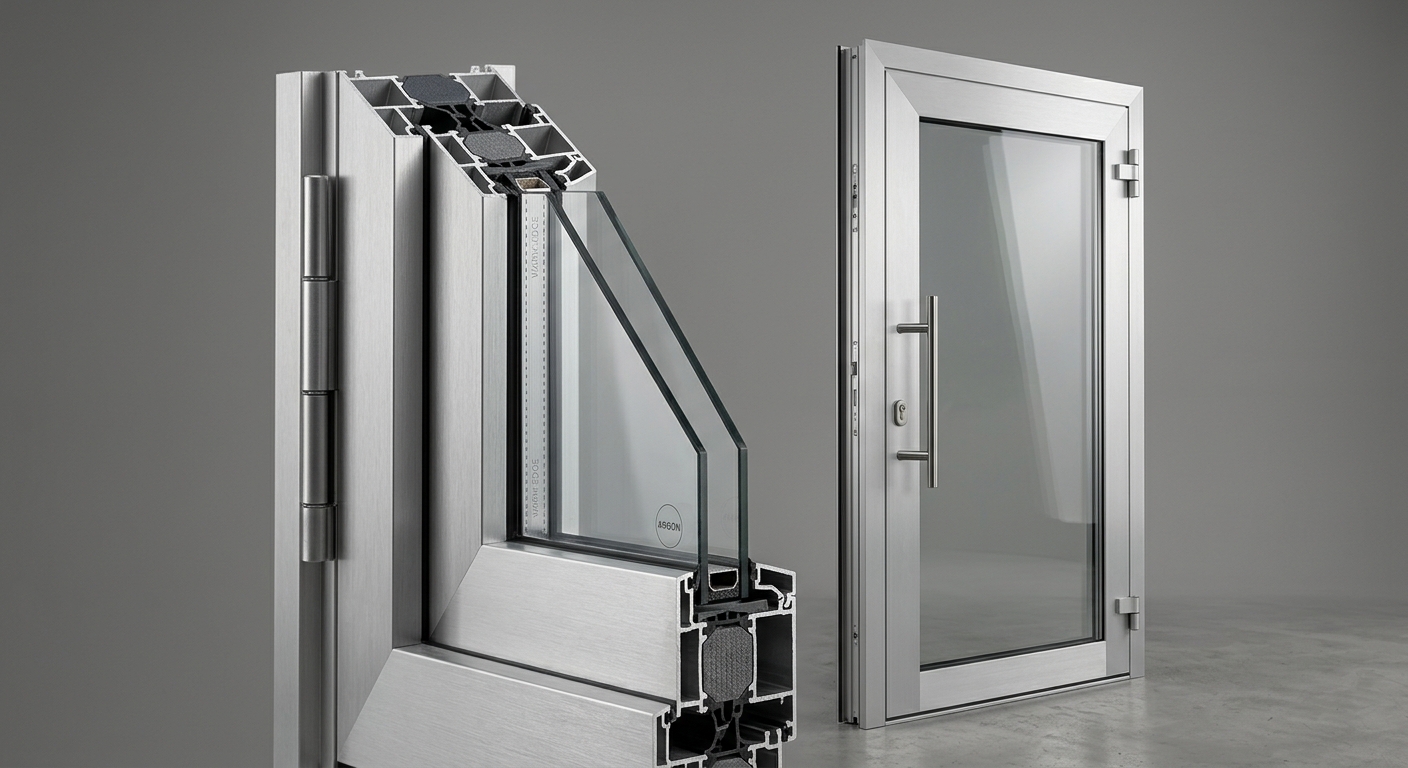
A thermal break interrupts the aluminum cold bridge by inserting a low-conductivity material between the exterior and interior aluminum profile sections. The industry-standard material is PA66 glass-fiber-reinforced polyamide, with a thermal conductivity of approximately 0.30 W/m·K — roughly 500 times lower than aluminum.
The polyamide strip is mechanically crimped or poured-and-debridged into the aluminum extrusion, creating a structurally bonded but thermally separated composite profile. Strip width is the single most critical specification variable:
- ≥24 mm strip width: Meets baseline European EN 14351-1 requirements; suitable for temperate climates with moderate humidity.
- ≥34 mm strip width: Required for cold-climate applications (zones with design temperatures below −10°C) or high-humidity interiors; achieves frame U-values in the 1.6–2.2 W/m²K range.
- ≥52 mm strip width: Passive house and ultra-low-energy building specifications; frame U-values approaching 1.0 W/m²K.
Beyond width, the geometry of the polyamide profile matters. Dual-chamber designs with additional insulating foam infill between the strips further reduce convective heat transfer within the frame cavity. Procurement teams should request documented compliance with EN 14351-1 (European window and door performance standard) or AAMA 507 (North American thermal performance standard for fenestration) as a minimum verification step.
2.2 Argon Gas Filling in the Insulating Glass Unit (IGU)
The IGU’s thermal performance depends on what fills the gap between the two glass panes. Standard air has a thermal conductivity of 0.024 W/m·K. Argon gas, at 0.016 W/m·K, reduces this by approximately 34%, meaningfully lowering the center-of-glass U-value and raising the interior glass surface temperature — directly reducing condensation risk on the glazing itself.
Argon is inert, non-toxic, and cost-effective relative to krypton alternatives. Its practical effectiveness depends on two additional factors:
- Spacer bar selection: Aluminum spacer bars conduct heat at the glass edge, creating a perimeter cold zone that undermines the IGU’s thermal performance. Warm-edge spacers — made from stainless steel, thermoplastic, or foam materials — reduce edge-of-glass heat loss by 20–30% and are essential for maximizing CRF (Condensation Resistance Factor) ratings.
- Gas retention rate: Argon fill rate at manufacture should be ≥90% (verified by EN 1279-3 testing). Over a 20-year service life with quality dual-seal construction, retention typically remains above 80%, preserving long-term thermal performance.
Performance Comparison Table
| Parameter | Standard Aluminum Door | Thermal Break Door (24 mm) | Thermal Break Door (≥34 mm) |
|---|---|---|---|
| Frame U-Value (W/m²K) | 5.5 – 7.0 | 2.8 – 3.5 | 1.6 – 2.2 |
| Glass Unit U-Value (W/m²K) | 2.8 (air-filled) | 1.6 (argon, warm-edge) | 1.1 (argon, warm-edge) |
| Condensation Resistance Factor (CRF) | 35 – 45 | 55 – 65 | 70 – 80 |
| Argon Gas Fill Rate | None | ≥90% | ≥90% |
| Applicable Climate Zone | Mild/Subtropical | Temperate/Continental | Cold/Subarctic |
3. Specification and Compliance Benchmarks for Procurement
3.1 Key Performance Parameters Buyers Must Verify
Procurement teams should move beyond surface-level product claims and request documented test data for the following parameters:
- Overall door U-value (Ud): The whole-door value integrating frame, glass, and edge effects. Target ≤2.0 W/m²K for temperate climates; ≤1.4 W/m²K for cold climates.
- CRF rating: A minimum CRF of 55 is recommended for standard commercial applications; CRF ≥70 for high-humidity environments. CRF is measured per AAMA 1503 or equivalent.
- Spacer bar type: Require warm-edge spacer specification in writing. Aluminum spacers should be disqualifying in any climate with significant winter temperature differentials.
- Seal integrity: Dual-seal IGU construction (primary butyl seal + secondary polysulfide or silicone seal) is the baseline for argon retention and moisture ingress prevention.
- Thermal break bonding strength: Request EN 14024 compliance data confirming that the polyamide-aluminum mechanical bond meets structural load requirements, particularly for high-traffic entrance doors subject to repeated impact and wind pressure cycling.
3.2 Relevant International Standards and Testing Protocols
| Standard | Scope | Relevance |
|---|---|---|
| EN 14351-1 | Window/door performance (Europe) | Thermal, air, water, wind resistance |
| ISO 10077-1/2 | Thermal transmittance calculation | U-value verification methodology |
| EN 1279-3 | IGU gas fill rate testing | Argon retention verification |
| AAMA 507 | Thermal performance (North America) | Climate zone compliance |
| ENERGY STAR (Doors) | U-value and solar heat gain thresholds | US residential/commercial procurement |
| LEED v4 EA Credit | Building envelope performance | Commercial green building certification |
For projects targeting LEED certification, specifying thermal break aluminum double-glazed entrance doors with documented Ud ≤1.8 W/m²K contributes directly to Energy and Atmosphere credits by reducing the building’s heating and cooling load through the envelope.
4. Real-World Application Scenarios and Commercial Value
4.1 High-Risk Environments: Cold Climates, High-Humidity Interiors, and Coastal Projects
Certain building typologies present condensation risk factors that compound one another, making anti-condensation specification non-negotiable:
- Hotel lobbies: High occupancy generates elevated interior humidity. Revolving or swing entrance doors experience rapid thermal cycling as guests enter and exit. Standard aluminum frames in these conditions develop persistent condensation that damages flooring finishes, corrodes door hardware, and creates slip hazards.
- Cold-storage and food processing facility entrances: Interior temperatures may be near or below 0°C while exterior ambient temperatures vary seasonally. The thermal differential reverses in summer, requiring bidirectional condensation resistance.
- Coastal commercial buildings: Salt-laden humid air accelerates corrosion at any moisture accumulation point. Condensation on aluminum frames in coastal environments creates electrochemical conditions that degrade anodized or powder-coated surface treatments within 3–5 years if frames lack adequate thermal protection.
- Healthcare and laboratory buildings: Humidity control is critical for infection prevention and equipment protection; entrance door condensation introduces uncontrolled moisture into tightly managed environments.
4.2 ROI Case for Specifying Anti-Condensation Aluminum Doors
The cost premium for a thermal break aluminum double-glazed entrance door over a standard aluminum door is typically 15–25% at procurement. The financial justification becomes straightforward when lifecycle costs are modeled:
- Energy savings: A door with Ud of 1.6 W/m²K vs. 5.5 W/m²K reduces heat loss through the door assembly by approximately 70%. For a commercial building with multiple entrance doors operating through a 180-day heating season, annual HVAC savings can offset the premium within 3–5 years.
- Maintenance cost reduction: Eliminating condensation removes the primary cause of sealant failure, frame corrosion, mold remediation, and hardware replacement cycles that standard aluminum doors require every 5–8 years in cold or humid climates.
- Building envelope warranty: Many building envelope warranties require fenestration products to meet minimum thermal performance thresholds. Specifying non-compliant doors can void broader warranty coverage.
- Occupant satisfaction and liability: Persistent door sweating creates slip-and-fall liability at entrances and generates tenant complaints that affect lease renewal rates in commercial properties.
أسئلة شائعة
Q1: At what indoor/outdoor temperature differential does an aluminum entrance door typically start to sweat?
For a standard aluminum door (no thermal break) in an interior environment at 20°C and 50% relative humidity, condensation begins when the interior frame surface drops below approximately 9°C — the dew point for those conditions. This typically occurs when the outdoor temperature falls below −2°C to +2°C, depending on frame geometry and air movement. With a 34 mm thermal break, the interior frame surface remains above dew point until outdoor temperatures reach approximately −15°C under the same interior conditions.
Q2: Does a thermal break guarantee zero condensation, or are there installation factors that still cause sweating?
A thermal break significantly reduces condensation risk but does not eliminate it if installation is deficient. The most common failure points are: inadequate perimeter sealing between the door frame and the rough opening (creating cold air infiltration channels), missing or damaged threshold insulation, and improper drainage of the glazing rebate. Specifying the door correctly is necessary but not sufficient — installation quality control and site inspection at the frame-to-structure junction are equally critical.
Q3: How can a procurement team verify that an aluminum door’s argon gas fill rate meets the specified performance level before purchase?
Request EN 1279-3 test reports from the IGU manufacturer, which document initial fill rate and simulated long-term retention. For project-critical applications, third-party verification using spark discharge testing or gas chromatography analysis on sample units from the production batch is available through accredited fenestration testing laboratories. Reputable suppliers will provide batch-specific test documentation as standard practice.
الخاتمة
The causal chain from aluminum’s thermal conductivity to door condensation is direct and predictable: unbroken aluminum profiles conduct cold to interior surfaces, chilling them below dew point and triggering moisture deposition. Double glazing improves center-of-glass performance but leaves the frame — the thermally dominant component in a standard aluminum door — unaddressed.
Two specification levers break this chain decisively. Thermal break width (minimum 24 mm for temperate climates, ≥34 mm for cold or high-humidity applications) interrupts the cold bridge at the frame level. Argon gas filling with warm-edge spacers raises interior glass surface temperatures and eliminates the secondary condensation zone at the glass perimeter.
For procurement teams, the action directive is clear: require documented U-value and CRF data, specify thermal break width and spacer type in writing, and verify IGU gas fill rates through supplier test documentation. These are not premium features — they are baseline specifications for any aluminum double-glazed entrance door deployed in a climate with meaningful seasonal temperature variation. Suppliers who cannot provide this documentation should not be shortlisted.