

Abstract
The assumption that glass doors are inherently weak entry points is one of the most persistent misconceptions in commercial building security. This belief drives poor specification decisions, leaves procurement managers exposed to liability, and results in costly post-breach remediation. The reality is that modern Double Glazed Security Sliding Doors are engineered systems — not simply glass panels in a frame — designed to resist forced entry through layered material science, structural engineering, and verified compliance testing.
This article addresses three dimensions that define genuine security performance: the physics of how double-glazed units (DGUs) resist impact, the structural vulnerabilities that burglars actually exploit, and the certification frameworks that separate verified security claims from marketing language. Whether you are specifying doors for a retail frontage, a residential complex, or a mixed-use development, understanding these principles will allow you to build a defensible procurement specification and select products that perform under real-world threat conditions.
1. The Science Behind the Glass: Why Double Glazing Resists Forced Entry
1.1 How the Double Glazed Unit (DGU) Structure Distributes Impact Force
A standard single-pane glass panel fails through a simple mechanism: concentrated impact stress exceeds the tensile strength of the glass at a single point, initiating a crack that propagates instantly across the surface. A Double Glazed Security Sliding Door operates on an entirely different physical principle.
The DGU consists of two glass panes separated by a sealed cavity — typically 12mm to 20mm — filled with argon or air. When an impact force is applied, the outer pane absorbs and partially deflects the initial energy. The cavity acts as a mechanical buffer, interrupting force transmission before it reaches the inner pane. This energy dissipation across two independent structural layers means that the force required to breach both panes sequentially is exponentially greater than breaching a single pane.
For a burglar attempting forced entry, this translates to significantly increased time-on-target — the primary deterrent in opportunistic break-ins. Studies consistently show that intruders abandon attempts lasting more than 60 seconds. A properly specified DGU system can sustain attack resistance well beyond this threshold.
1.2 Laminated vs. Toughened Glass: Which Core Material Matters More for Security
The glass specification within the DGU is the single most important material decision in security performance. Two core options dominate the market:
Laminated glass bonds two or more glass plies with an interlayer — either PVB (polyvinyl butyral) or the higher-performance SGP (SentryGlas® Plus). Upon impact, the glass may crack, but the interlayer holds the fragments in place, maintaining the barrier. SGP interlayers offer approximately five times the tear resistance of standard PVB, making them the preferred specification for high-security applications. Critically, laminated glass resists penetration even after the glass itself has fractured.
Toughened (tempered) glass is approximately four times stronger than annealed glass in impact resistance. However, when it does fail, it shatters into small granular fragments — removing the barrier entirely. For security applications, this failure mode is a significant liability.
The security-optimized configuration combines both: a toughened outer pane (impact resistance) with a laminated inner pane (penetration resistance after fracture).
| Glass Type | Impact Resistance | Fracture Pattern | Penetration Resistance | Best Security Application |
|---|---|---|---|---|
| Standard Annealed | Low | Large sharp shards | None | Non-security use only |
| Toughened/Tempered | High | Small granular fragments | None after fracture | Outer pane in DGU |
| Laminated (PVB) | Medium | Held in place by film | Moderate | Mid-security inner pane |
| Laminated (SGP) | Medium-High | Held in place by film | High | High-security inner pane |
| Toughened + Laminated DGU | Very High | Outer shatters; inner holds | Very High | Commercial security standard |
2. Frame, Lock & Track: The Structural Components Burglars Actually Target
2.1 Frame Material and Corner Joint Integrity Under Forced Load
Experienced burglars rarely attack glass directly — it is noisy, time-consuming, and physically hazardous. The frame is the preferred attack vector because frame failures are faster, quieter, and require less specialized tools. This is where many ostensibly “secure” sliding doors fail in practice.
Frame performance depends on two factors: material specification and fabrication quality. Aluminium alloy frames — particularly those using 6063-T5 or 6061-T6 alloy profiles — offer the optimal combination of tensile strength and corrosion resistance for commercial applications. The critical specification is wall thickness: security-grade frames require a minimum 2.0mm wall thickness, with 2.5mm or greater for high-risk environments. Thinner profiles deflect under crowbar load, allowing the sash to separate from the frame without glass failure.
Corner joint integrity is equally decisive. Mechanically fastened corner joints — common in lower-cost frames — introduce a structural weak point that fails under lateral forced load. Welded corner joints, standard in quality aluminium security frames, maintain structural continuity under the same load conditions. When evaluating suppliers, request documentation of corner joint fabrication method and load-test results.
uPVC frames offer comparable thermal performance but require internal steel reinforcement profiles to achieve equivalent security ratings. Unreinforced uPVC frames should not be specified for any commercial security application.
2.2 Multi-Point Locking Systems and Anti-Lift Track Design
Three primary attack paths exist for sliding door bypass: prying the sash laterally, lifting the panel off its track, and manipulating the lock cylinder. A security-grade sliding door must address all three simultaneously.
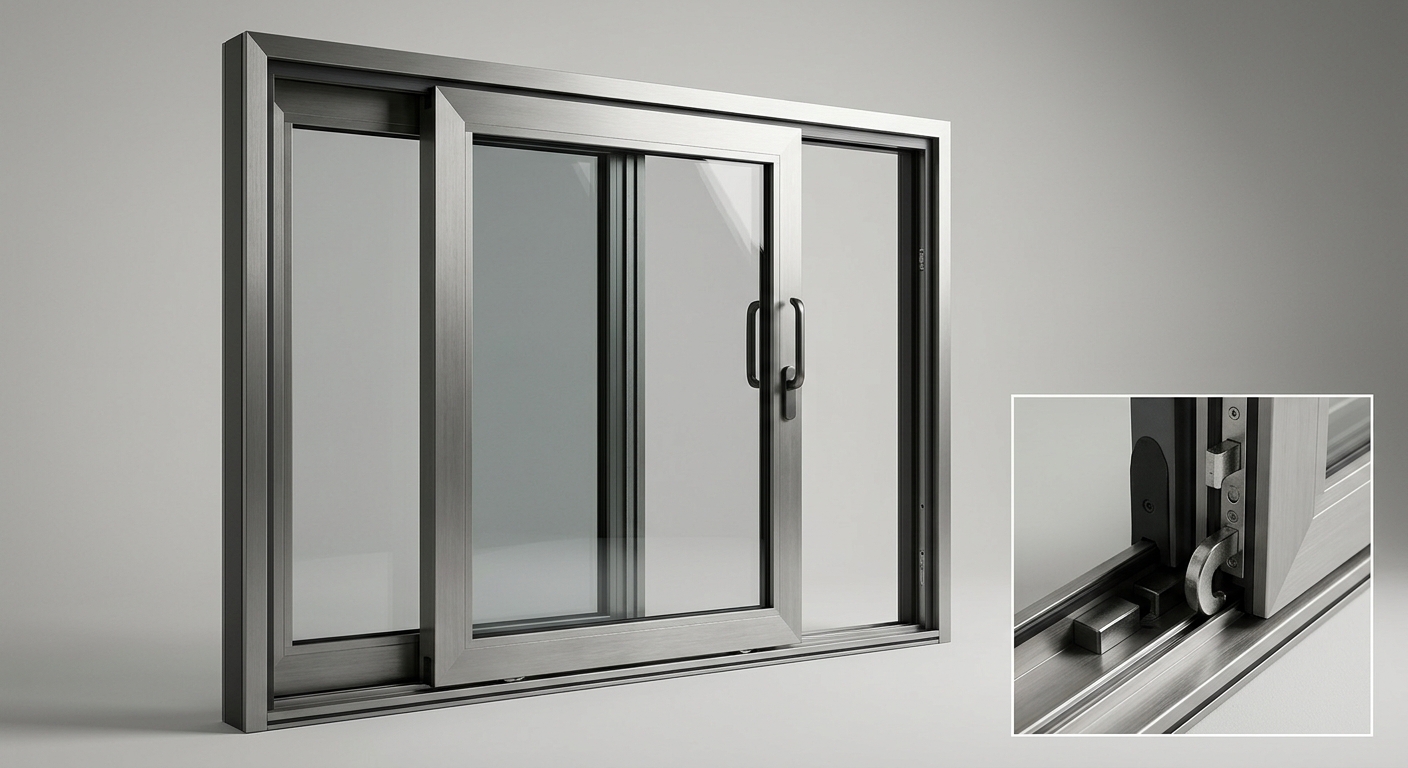
Multi-point locking systems engage the frame at three or more points — top, bottom, and centre — when the door is locked. This distributes any forced lateral load across the full height of the frame, preventing the localized deflection that allows single-point locks to be defeated by a crowbar. Look for systems with anti-pick, anti-drill lock cylinders rated to EN 1303 or equivalent.
Anti-lift track design prevents panel removal by incorporating a secondary retention channel that limits vertical panel travel to less than the track depth. Without this feature, a sliding panel can be lifted free of the bottom track and tilted out of the frame — bypassing the lock entirely. Security-grade tracks integrate adjustable anti-lift blocks as a standard feature, not an optional upgrade.
Together, these two systems close the three primary attack vectors. A door lacking either component cannot be legitimately marketed as a security product regardless of its glass specification.
3. Security Ratings & Compliance Standards: What the Certifications Actually Mean
3.1 Key International Standards: PAS 24, EN 1627, and ANSI/BHMA Ratings Decoded
Three certification frameworks govern security door performance across major commercial markets:
PAS 24:2022 (UK) is the baseline security standard for enhanced doorsets. It tests the complete assembled unit — glass, frame, hardware, and fixings — against manual attack using defined tools and time limits. Compliance is mandatory for Secured by Design accreditation and is increasingly required by UK insurers for commercial premises.
EN 1627 (Europe) defines six resistance classes (RC1–RC6). RC2 is the minimum recommended for residential and light commercial applications; RC3 is appropriate for most commercial retail environments; RC4 and above address high-value or high-threat scenarios. The standard specifies both a manual attack test (EN 1628) and a static load test (EN 1630).
ANSI/BHMA A156.115 (North America) grades commercial door hardware on a 1–3 scale, with Grade 1 representing the highest commercial duty. This standard addresses hardware durability and cycle testing but should be evaluated alongside ASTM impact standards for a complete security assessment.
When reviewing a manufacturer’s certification claims, verify that the certificate covers the specific product configuration being purchased — glass specification, frame profile, and hardware — not a representative sample that differs from the delivered product.
3.2 How to Verify a Manufacturer’s Security Claims Before Purchase
Security certification fraud and grade misrepresentation are documented problems in the door and window supply chain. Verification requires more than accepting a certificate image in a sales presentation.
Key verification steps:
- Request the full test report, not just the certificate. The report identifies the exact tested configuration, test date, and testing body.
- Cross-reference the certificate number against the issuing body’s public registry (e.g., BRE Global for Secured by Design, notified bodies for CE marking under EN 1627).
- Confirm that the tested product’s glass specification, frame dimensions, and hardware match your purchase order exactly.
- Request the manufacturer’s quality management documentation confirming production consistency with the tested configuration.
Red flags include certificates without visible test body accreditation numbers, claims of “equivalent to RC3” without formal certification, and resistance to providing full test documentation.
4. Real-World Application Scenarios: Matching Security Level to Commercial Risk
4.1 High-Risk Environments: Retail Frontages, Residential Complexes, and Mixed-Use Developments
Security specifications should be risk-calibrated, not uniform. Over-specifying adds unnecessary cost; under-specifying creates liability exposure.
| Application | Minimum Security Rating | Recommended Glass Specification | Lock Requirement |
|---|---|---|---|
| Residential complex entrance | PAS 24 / RC2 | 6.4mm laminated inner pane | Multi-point, EN 1303 cylinder |
| Retail frontage (standard) | RC2–RC3 | 6.4mm SGP laminated inner pane | Multi-point + anti-lift track |
| High-value retail/jewellery | RC3–RC4 | 10.8mm SGP laminated inner pane | RC3-rated multi-point system |
| Mixed-use ground floor | RC2 minimum | Toughened outer + laminated inner | Multi-point, anti-lift track |
For retail frontages with extended unmanned periods — overnight or weekend closures — RC3 with SGP laminated glass is the commercially defensible minimum. Insurance underwriters for commercial property increasingly reference EN 1627 resistance class in policy conditions.
4.2 Total Cost of Security: Upfront Specification vs. Post-Breach Liability
The commercial case for correct security specification is straightforward when total cost is modeled accurately. A retail break-in generates costs across four categories: stolen inventory, property damage and repair, business interruption, and insurance premium adjustment. Average commercial burglary losses frequently exceed the cost differential between a standard and security-rated sliding door by a factor of 10 to 20.
Insurance premium structures increasingly reflect door security ratings directly. Properties specifying PAS 24 or EN 1627 RC3-compliant entrances qualify for measurably lower commercial property premiums with major underwriters. Over a five-year policy horizon, premium savings alone can offset the specification upgrade cost — before accounting for breach prevention value.
The procurement decision, framed correctly, is not “can we afford the security-rated door?” but “can we afford the liability exposure of the non-rated alternative?”
FAQ: Procurement Pain Points
Q1: Are double glazed sliding doors hard enough to break to meet insurance requirements for commercial premises?
Yes — provided the correct specification is selected and certified. Most UK commercial insurers now require PAS 24 compliance as a minimum for enhanced security endorsements. In European markets, EN 1627 RC2 is the typical baseline. Confirm your insurer’s specific requirements before finalizing the specification, and ensure the manufacturer can provide a test report covering the exact product configuration ordered.
Q2: Can a burglar bypass the glass entirely by attacking the frame or lock cylinder?
Yes, and this is the most common attack method. Frame attacks and lock manipulation are faster and quieter than glass breakage. This is why security performance must be evaluated at the system level — glass specification alone is insufficient. Specify security-grade frame wall thickness (minimum 2.0mm aluminium), welded corner joints, multi-point locking with EN 1303-rated cylinders, and anti-lift track as a complete package.
Q3: What is the minimum glass specification and security rating I should specify for a high-traffic retail entrance?
For standard retail, specify EN 1627 RC2 as the floor, with a DGU incorporating a toughened outer pane and a minimum 6.4mm SGP laminated inner pane. For high-value retail or extended unmanned periods, upgrade to RC3 with 10.8mm SGP laminated inner pane and a certified multi-point locking system. Always request the full third-party test report confirming these specifications as a tested assembly.
Fazit
The security performance of Double Glazed Security Sliding Doors is not a property of any single component — it is the outcome of a correctly integrated system. The DGU structure distributes impact energy across two independent panes. The glass specification — particularly SGP laminated inner panes — maintains the barrier after initial fracture. Security-grade frames with welded corner joints resist the crowbar attacks that defeat standard profiles. Multi-point locking and anti-lift track design close the bypass vectors that burglars actually use. And third-party certification to PAS 24, EN 1627, or equivalent standards provides the independently verified evidence that procurement specifications and insurance requirements demand.
For commercial procurement decisions, the framework is clear: define the risk environment, establish the minimum certification requirement, verify the manufacturer’s test documentation against the exact product configuration, and evaluate total cost across the full ownership horizon. A correctly specified security sliding door is not an overhead — it is a quantifiable risk mitigation asset.