
Abstract
Hurricane impact casement windows are purpose-engineered for the structural demands of coastal environments — extreme wind loads, airborne debris, and rapid pressure differentials that standard glazing systems cannot withstand. For B2B buyers including contractors, developers, and property managers, specifying the correct impact window system is both a code compliance obligation and a long-term asset protection decision.
This guide provides a technical and commercial evaluation framework covering the core engineering that makes these windows safe, the certification standards that validate performance, the specifications critical to coastal applications, and the procurement criteria that separate reliable suppliers from underperforming ones. Whether you are specifying windows for a high-velocity hurricane zone (HVHZ) residential development or a mixed-use coastal commercial project, the information here will support defensible, code-compliant procurement decisions.
1: What Makes Hurricane Impact Casement Windows Safe?
1.1: Core Engineering & Impact-Resistance Mechanisms
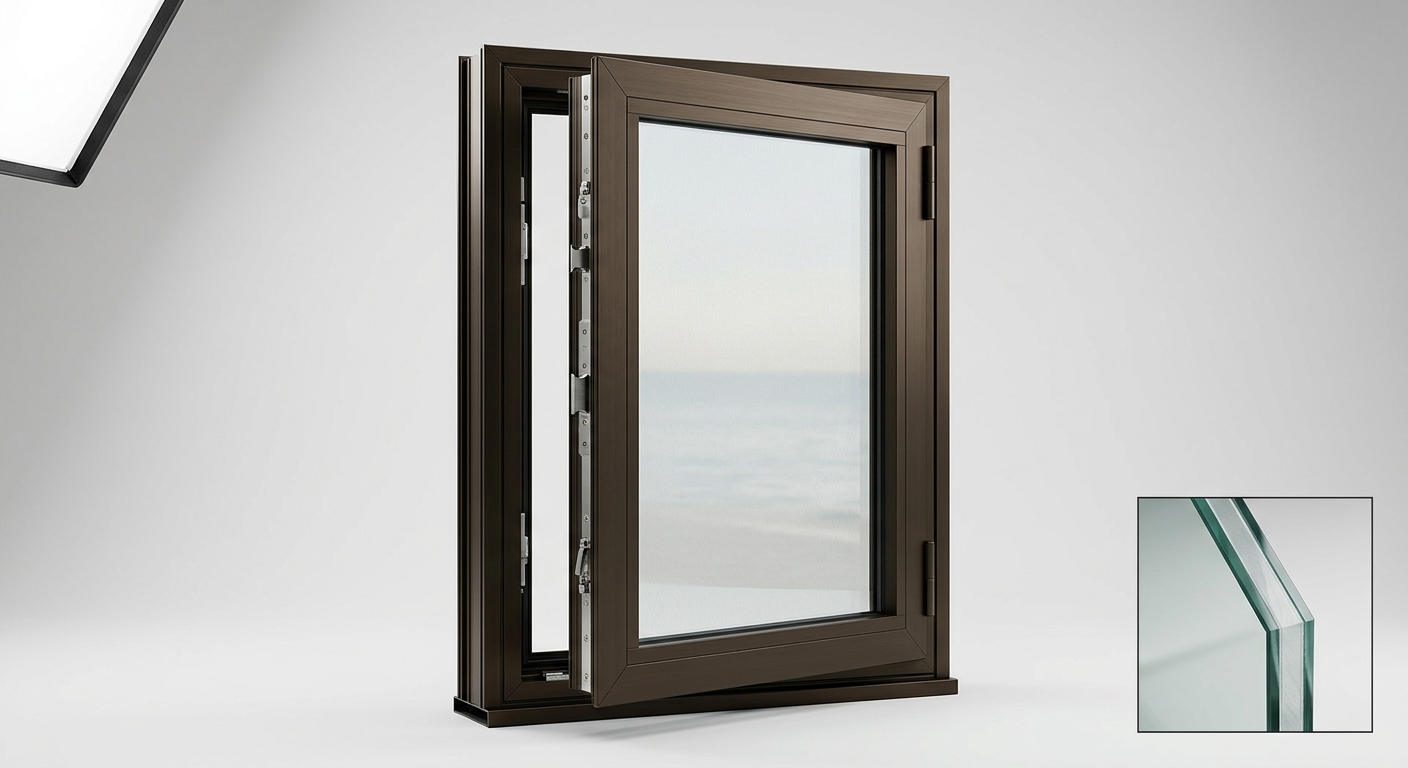
The safety of hurricane impact casement windows is rooted in two interdependent systems: the laminated glass assembly and the reinforced frame-and-hardware structure.
Laminated glass construction uses two or more panes of tempered or annealed glass bonded by a polymer interlayer. The two dominant interlayer technologies are:
- PVB (Polyvinyl Butyral): The standard interlayer for most residential-grade impact windows. PVB absorbs impact energy and holds glass fragments in place upon breakage, preventing dangerous shard penetration.
- SGP (SentryGlas® Plus): A stiffer, higher-tensile ionoplast interlayer used in performance-grade and commercial applications. SGP delivers up to five times the tear resistance of PVB and significantly reduces post-impact deflection, making it the preferred specification for large-format glazing in high-wind zones.
The glass assembly alone is insufficient without a structurally competent frame. High-performance impact casement windows incorporate multi-point locking mechanisms — typically three to five locking points distributed along the sash — that distribute wind load across the entire frame perimeter rather than concentrating stress at a single latch point. Frame corners are mechanically fastened and thermally broken or reinforced to prevent racking under sustained wind pressure.
1.2: Compliance Standards & Certifications That Validate Safety
Certifications are not marketing credentials — they are procurement prerequisites for any coastal specification. The four standards most relevant to hurricane impact casement windows are:
- ASTM E1886 / E1996: The foundational test protocols for impact resistance. E1886 defines the test method (large missile at 50 ft/s, small missile at 80 ft/s, cyclic wind pressure), while E1996 specifies the performance criteria by wind zone. Any window claiming hurricane impact compliance must reference both.
- Miami-Dade NOA (Notice of Acceptance): The most rigorous product approval in the U.S. market. Miami-Dade County’s HVHZ requirements exceed Florida statewide minimums. An NOA-listed product has passed independent third-party testing and is approved for use in the most demanding wind exposure categories.
- Florida Building Code (FBC): Mandates impact protection for glazed openings in wind-borne debris regions. Specifiers must verify that window products carry FBC Product Approval numbers applicable to the project’s wind speed contour.
- AAMA 506: Governs voluntary performance requirements for impact-resistant fenestration, providing a supplementary benchmark for air, water, and structural performance beyond basic impact compliance.
Hurricane Impact Casement Windows — Core Safety Parameter Comparison
| Parameter | Standard Grade | Performance Grade | Commercial/HVHZ Grade |
|---|---|---|---|
| Glass Construction | 3mm + PVB + 3mm | 4mm + SGP + 4mm | 6mm + SGP + 6mm |
| Interlayer Type | PVB (0.38mm) | SGP (0.89mm) | SGP (1.52mm) |
| 프레임 재료 | uPVC | Aluminum (6063-T5) | Thermally broken aluminum |
| Design Pressure (DP) | DP-35 | DP-50 | DP-65 to DP-90 |
| Impact Test Level | Small missile | Large missile | Large missile + cyclic |
| Certifications | FBC Product Approval | FBC + AAMA 506 | Miami-Dade NOA + FBC |
| Applicable Wind Zone | Zone 3 | Zone 4 | Zone 4 / Zone 5 / HVHZ |
2: Key Performance Specifications for Coastal Applications
2.1: Wind Load & Impact Resistance Ratings
Design Pressure (DP) rating is the primary structural metric for specifying impact casement windows. DP ratings measure the window’s ability to resist positive and negative wind pressure, expressed in pounds per square foot (PSF).
- DP-35 to DP-50: Suitable for most coastal residential applications outside HVHZ, corresponding to wind speeds up to approximately 130–150 mph.
- DP-65 and above: Required for HVHZ projects, high-rise facades, and exposure category D sites where sustained wind speeds exceed 160 mph.
For impact classification, ASTM E1996 distinguishes between large missile testing (a 9-lb 2×4 lumber at 50 ft/s, simulating structural debris) and small missile testing (ten 2-gram steel balls at 130 ft/s, simulating gravel). Coastal residential and commercial specifications in Wind Zone 4 and Zone 5 universally require large missile compliance — small missile ratings alone are insufficient for occupied structures in hurricane-prone regions.
2.2: Water Infiltration, Air Leakage & Thermal Performance
Coastal environments impose additional performance demands beyond structural load resistance. Specifiers should verify:
- Water resistance: Rated per ASTM E331/E547. Look for a minimum water resistance pressure of 15% of the design pressure, with zero infiltration at that test pressure.
- Air infiltration: AAMA 101 Class A maximum is 0.30 CFM/ft² at 1.57 PSF. High-performance casement windows with compression seals routinely achieve 0.01–0.05 CFM/ft², significantly reducing HVAC load in coastal climates.
- Salt-air corrosion resistance: Hardware and frame finishes must be rated for marine environments. Stainless steel or marine-grade coated hardware, combined with anodized or PVDF-coated aluminum frames, is the minimum standard for oceanfront applications within 1,000 feet of saltwater.
- Thermal performance: Coastal projects in hot-humid climates benefit from low-E coatings on the impact glass assembly, reducing solar heat gain coefficient (SHGC) without compromising impact integrity.
3: How to Choose the Best Hurricane Impact Casement Windows for Coastal Homes
3.1: Frame Material & Hardware Selection for Coastal Environments
Frame material selection directly affects both structural performance and long-term maintenance cost:
Aluminum frames (6063-T5 or 6061-T6 alloy): The preferred specification for coastal commercial and high-performance residential projects. Aluminum offers superior strength-to-weight ratio, dimensional stability under thermal cycling, and compatibility with high-DP glazing assemblies. Thermally broken aluminum frames add condensation resistance for air-conditioned interiors in humid coastal climates. Anodized Class I (0.7 mil minimum) or PVDF/Kynar coatings provide the corrosion resistance required within 1,500 feet of saltwater.
uPVC frames: Cost-effective for residential applications in moderate wind zones. uPVC does not corrode, but its lower structural rigidity limits achievable DP ratings. Reinforced uPVC with galvanized steel inserts bridges this gap but requires verification that inserts are fully encapsulated to prevent corrosion.
Hardware specifications: Multi-point locking hardware must carry a minimum AAMA 910 cycle rating (10,000 operations) and be manufactured from 316 stainless steel or marine-grade zinc alloy. Exposed fasteners should be A4 stainless or hot-dip galvanized.
3.2: Procurement Checklist — What Contractors & Developers Must Verify
Before issuing a purchase order for hurricane impact casement windows on a coastal project, verify the following:
- [ ] NOA or FBC Product Approval number applicable to the project’s wind speed and exposure category
- [ ] Third-party test reports (ASTM E1886/E1996) from an accredited laboratory — not self-certified data
- [ ] DP rating meets or exceeds the project’s calculated design wind pressure per ASCE 7
- [ ] Glazing configuration (glass thickness, interlayer type, IGU or monolithic) matches the specification
- [ ] Supplier warranty: Minimum 10-year product warranty; verify it covers coastal/marine environments explicitly
- [ ] Lead time: Impact window lead times in coastal markets commonly run 8–14 weeks; confirm production slots before project scheduling
- [ ] Installation clearance requirements: Confirm anchor spacing, substrate requirements, and flashing details are documented in the NOA installation instructions
4: Commercial & Residential Application Scenarios
4.1: Coastal Residential Projects — Risk Zones & Window Placement Strategy
Florida’s High-Velocity Hurricane Zone (HVHZ) — encompassing Miami-Dade and Broward counties — imposes the most stringent opening protection requirements in the U.S. All glazed openings in HVHZ must be protected by either NOA-listed impact products or approved storm shutter systems. Impact casement windows eliminate the operational burden of shutter deployment while providing continuous, code-compliant protection.
Beyond HVHZ, ASCE 7 wind speed maps define wind-borne debris regions where impact protection is triggered. Facade exposure categories (B, C, D) further influence required DP ratings based on terrain roughness and proximity to open water. Oceanfront facades in Exposure Category D require the highest DP specifications — typically DP-65 or above for two-story and above structures.
Window placement strategy in coastal residential design should prioritize large-opening casement configurations on windward elevations, where both positive and negative pressure loads are highest, and verify that the specified window carries both positive and negative DP ratings matching the structural engineer’s calculations.
4.2: ROI & Insurance Benefits for Property Developers
The commercial case for specifying hurricane impact casement windows extends well beyond code compliance:
- Insurance premium reductions: Florida homeowners with fully protected openings (impact windows on all glazed openings) qualify for wind mitigation credits under the Florida Uniform Mitigation Verification Inspection form, with documented premium reductions of 20–45% on wind/hurricane coverage.
- Property value uplift: Coastal properties with certified impact window systems command measurable premiums. Appraisers in South Florida and Gulf Coast markets recognize impact glazing as a value-additive feature, particularly in the luxury residential segment.
- Lifecycle cost advantage: Over a 20-year horizon, impact casement windows eliminate recurring storm shutter purchase, storage, installation labor, and post-storm inspection costs. For multi-unit coastal developments, this operational saving is substantial.
- Reduced post-storm liability: For commercial property managers, certified impact glazing reduces exposure to business interruption and tenant displacement claims following hurricane events.
FAQ
1. Are hurricane impact casement windows strong enough to replace storm shutters in Category 5 zones?
Yes — provided the windows carry Miami-Dade NOA approval and are installed per the manufacturer’s approved installation instructions. NOA-listed impact casement windows are tested to wind loads exceeding Category 5 hurricane conditions (156+ mph sustained winds) and are accepted by Florida Building Code as complete opening protection without supplementary shutters.
2. What certifications should I require from a supplier before specifying impact casement windows on a coastal project?
At minimum, require a valid Miami-Dade NOA or FBC Product Approval number, third-party ASTM E1886/E1996 large missile test reports from an accredited laboratory, and AAMA 506 compliance documentation. For projects outside Florida, verify that the product meets the applicable state or local wind-borne debris protection standard.
3. How do I verify that hurricane impact casement windows meet local building code requirements for my specific coastal region?
Cross-reference the supplier’s Product Approval or NOA number against the project’s calculated design wind pressure (from a licensed structural engineer per ASCE 7) and the local Authority Having Jurisdiction (AHJ) acceptance list. The NOA installation instructions will specify approved substrates, anchor patterns, and clearance requirements — deviation from these voids the approval.
결론
Hurricane impact casement windows are a validated, code-compliant solution for coastal residential and commercial projects where structural integrity, occupant safety, and long-term asset protection are non-negotiable requirements. The safety case rests on three pillars: laminated glass assemblies with SGP or PVB interlayers that contain impact energy and prevent breach; reinforced aluminum or uPVC frames with multi-point locking systems that maintain structural integrity under extreme wind loads; and third-party certifications — Miami-Dade NOA, FBC Product Approval, ASTM E1886/E1996 — that provide independent validation of performance claims.
For procurement professionals, the specification decision should be driven by verified DP ratings matched to site-specific wind pressure calculations, confirmed large missile impact compliance for Wind Zones 4 and 5 applications, marine-grade hardware and corrosion-resistant frame finishes for high-salinity environments, and supplier documentation that supports AHJ approval without delays. The ROI case — insurance premium reductions, property value uplift, and elimination of recurring shutter costs — makes certified hurricane impact casement windows the financially rational specification choice for any serious coastal development program.